The Maker ERP: Transitioning from 'Counting Items' to 'Building a Manufacturing Engine'
You probably started with a spreadsheet. Most of us did. It was just a list: 50 glass jars, 10 lbs of wax, 5 scent bottles.
But then something happened. Your business grew from a 'hobby' into a 'production floor.' Suddenly, you weren't just counting jars; you were calculating the fractional grams of fragrance oil lost during the pour. You were trying to figure out why your 3D print farm's 'spaghetti waste' wasn't showing up in your profit margins. You were realizing that 'Inventory Tracking' is a passive list, but what you actually need is an active engine.
That engine is a Maker ERP.
What Exactly is a 'Maker ERP'?
ERP stands for Enterprise Resource Planning. In the corporate world, that usually means a $40,000 software suite that requires a full-time IT department to manage.
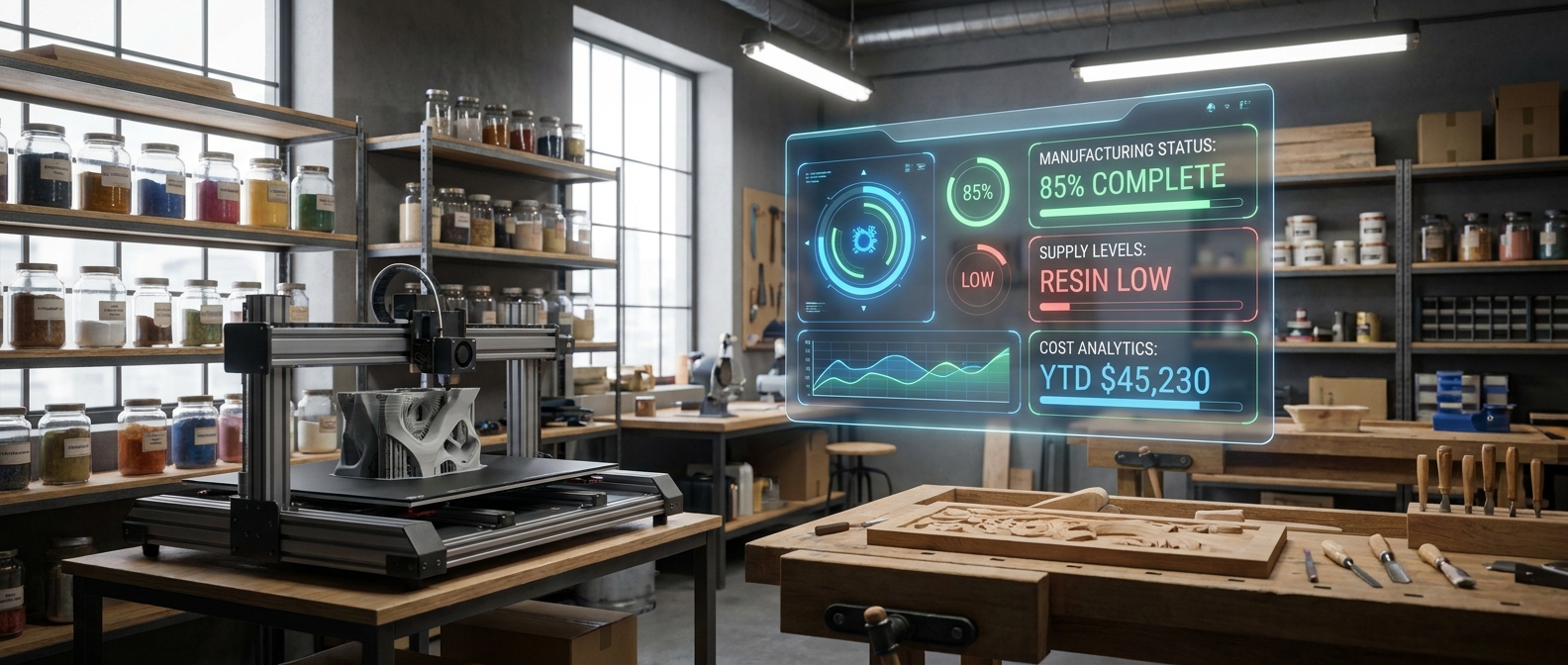
For us—the artisans, the engineers, and the makers—a Maker ERP is a different beast. It’s an industrial-grade manufacturing brain designed for the scale of a workshop, not a skyscraper. It doesn't just tell you that you have '3 bottles of oil' left. It tells you exactly how many 8oz candles you can produce right now based on your current fragrance load, accounts for the curing waste, and automatically calculates the Cost of Goods Sold (COGS) the second you log a batch.
The 3 Pillars of a True Maker ERP
Most 'small business inventory' tools are glorified checklists. A Maker ERP (like Vercos) is built on three different pillars: Physics, Time, and Money.
1. The Physics: Fractional Deduction
If you’re a soap maker or a jeweler, you don't deal in 'units' of raw materials. You deal in milligrams, milliliters, and board feet.
- The Spreadsheet Problem: You buy 1kg of filament. Your slicer says a print used 42g. Subtracting 42 from 1000 in a cell every time you print is a recipe for error.
- The ERP Solution: When you log a 'Print Task,' the ERP pulls exactly 42g from that specific spool. It accounts for the weight of the spool itself. It recognizes that 5g was lost to supports. This is fractional deduction, and it’s the only way to get a true inventory count.
2. The Time: Machine & Labor Tracking
In a maker business, your biggest expense isn't always the material; it's the machine time and the 'maker tax' (your own hands).
- 3D Printing: A Maker ERP factors in the nozzle depreciation and electricity cost per hour.
- Woodworking: It lets you log 'Commission Time' directly against a project, so your invoice reflects the 14 hours of sanding, not just the board feet of walnut used.
3. The Money: Automated COGS
This is the part that saves you at tax time (Schedule C or T2125). A Maker ERP treats every batch as a financial transaction.
When you move 10 bars of soap from 'Curing' to 'Ready for Sale,' the ERP calculates the exact cost of the lye, oils, fragrance, and labor used to create those bars. It carries that cost until the item is sold. No more guessing your margins. No more 'best-guess' spreadsheets on December 31st.
Why 'Inventory Software' is Failing Your Workshop
Tools like Inventora or basic Shopify plugins treat inventory as a static number. They are great for retailers who buy a finished product and resell it.
But you are a manufacturer.
You change the state of matter. You turn liquid wax into a solid candle. You turn a digital file into a physical 3D object.
When your 'inventory' tool doesn't understand Yield (e.g., 'I put 1000ml in, but only 950ml ended up in bottles'), it creates a 'Ghost Inventory' problem. You think you have stock that isn't actually there because the software didn't account for the waste inherent in the making process.
Is it Time for an Upgrade?
If any of these sound familiar, you’ve officially outgrown your spreadsheet:
- The 'Oversell' Panic: You sold a product on Etsy only to realize you’re out of one specific jump ring or a specific shade of mica.
- The 'Margin Mirage': You’re making sales, but the bank account isn't growing. You suspect your 'Material Cost x 3' pricing isn't actually covering your overhead.
- The Spreadsheet Ceiling: You spend more time updating cells than you do at the workbench.
The Vercos Difference
We didn't build Vercos ERP because we wanted to sell software. We built it because we were tired of the 'spreadsheet chaos' in our own workshops. We wanted something that was as precise as a digital caliper but as easy to use as a shop vac.
A Maker ERP shouldn't be a chore; it should be the most reliable tool on your bench. It’s the brain that handles the math so you can get back to the craft.
Ready to move from a list to an engine? Explore Vercos ERP for your workshop.
TL;DR Summary
- A Maker ERP is an active manufacturing engine, not just a passive inventory list.
- Key features include fractional material deduction for precise tracking of raw materials like grams and milliliters.
- It automates COGS calculations by treating every production batch as a financial transaction.
- It accounts for manufacturing waste and machine time, solving the 'Ghost Inventory' problem.