The Hidden Math of 3D Printing: Why Your "Successful" Prints Are Lying to Your Margins
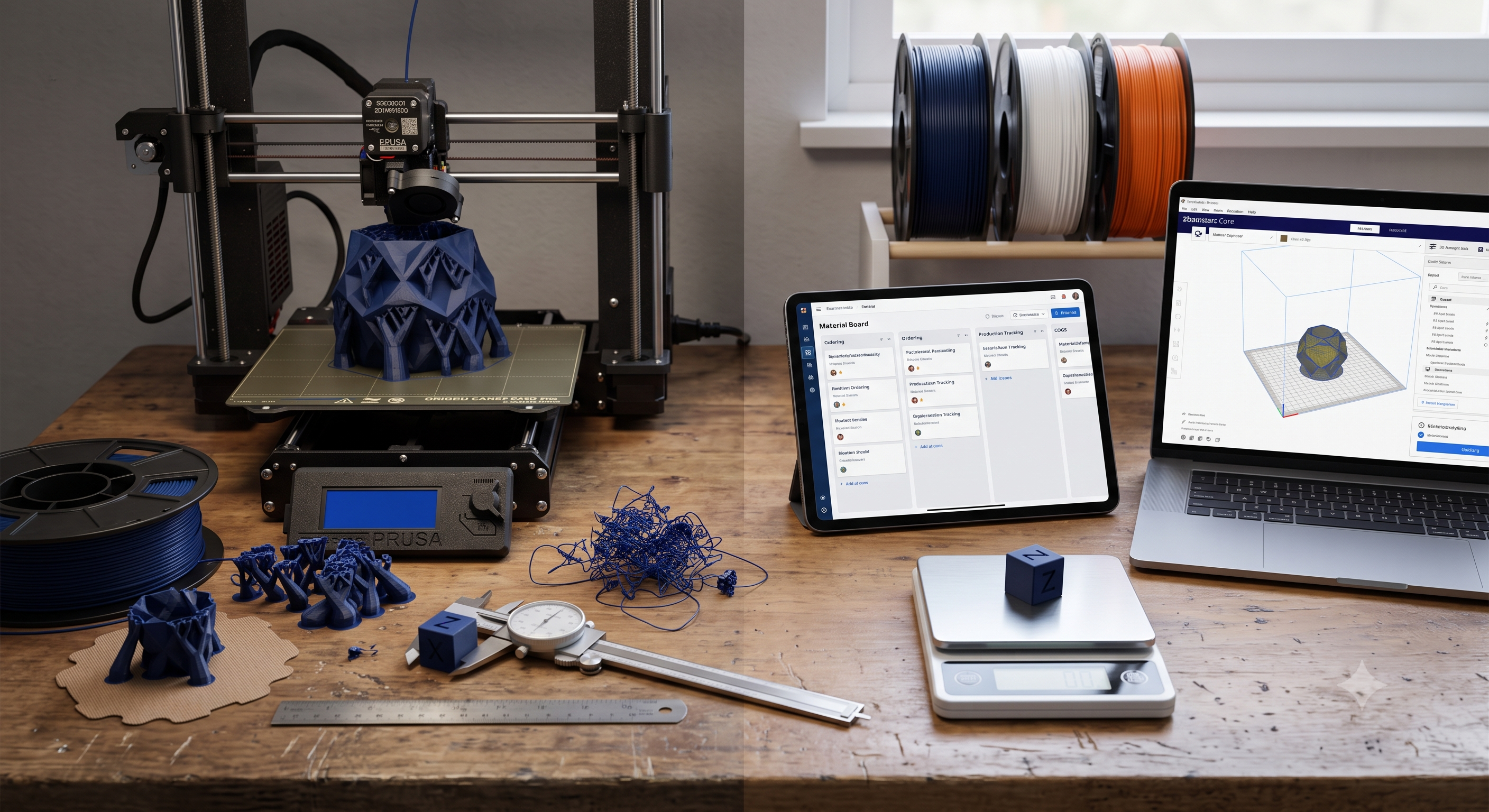
There is nothing quite like the hum of a fully operational 3D print farm. Walking into the workshop and seeing twenty machines flawlessly laying down perfect first layers is an incredible feeling.
But if you are running a commercial print farm, you already know the dark side of this business: the math.
When I first scaled up my printers, I thought the profitability equation was simple. If a spool of PLA costs $20 and a custom planter takes 200 grams to print, my material cost is $4. Sell it for $25 on Etsy, and I’m making a killing, right?
Wrong. So incredibly wrong.
If you are currently looking at your Shopify dashboard and wondering why your actual bank account balance doesn't match your "profits," you are likely falling into the same spreadsheet trap I did. Standard inventory software—and basic spreadsheet math—only tracks the weight of the successful, finished object.
It completely ignores the reality of the print farm floor.
What about the 15 grams of filament used for the skirt and tree supports? What about the 50 grams lost to a mid-print spaghetti failure? What about the purge lines and color changes? Every single time you scrape a failed print off the build plate and throw it in the trash, you are throwing away your profit margin.
If you don't track your waste, your Cost of Goods Sold (COGS) is a complete guess.
And that doesn't even touch on machine depreciation. Running printers 24/7 means replacing brass nozzles, replacing worn-out belts, and dealing with blown thermistors. If you aren't factoring the cost of machine maintenance into the price of your prints, you are essentially subsidizing your customers' purchases out of your own pocket.
Trying to track fractional filament depletion and machine wear-and-tear in a spreadsheet is a nightmare. I spent hours every Sunday trying to manually deduct half-empty spools from my digital inventory just so I wouldn't accidentally take a massive wholesale order without enough material on hand.
I got so frustrated with the lack of software for actual physical manufacturers that I put on my developer hat and built Vercos ERP.
I designed it specifically for the reality of 3D printing. When you log a production run in Vercos ERP, it doesn't just deduct the final weight of the object. It has a dedicated "Failed Print & Support Waste" logger. It deducts the exact fractional grams from your digital filament shelves, updates your true COGS instantly, and even allows you to log machine maintenance so you know exactly what your farm actually costs to run.
Stop letting hidden waste eat your margins. We are currently opening the doors for our First Adopter Collective, giving a handful of active makers free early access to help us refine the engine.
If you're ready to ditch the spreadsheets and start treating your farm like a real manufacturing business, claim your spot on the site. I'll see you in the workshop.