The Hidden Costs of “Free Shipping”: Are You Accidentally Paying Customers to Take Your Products?
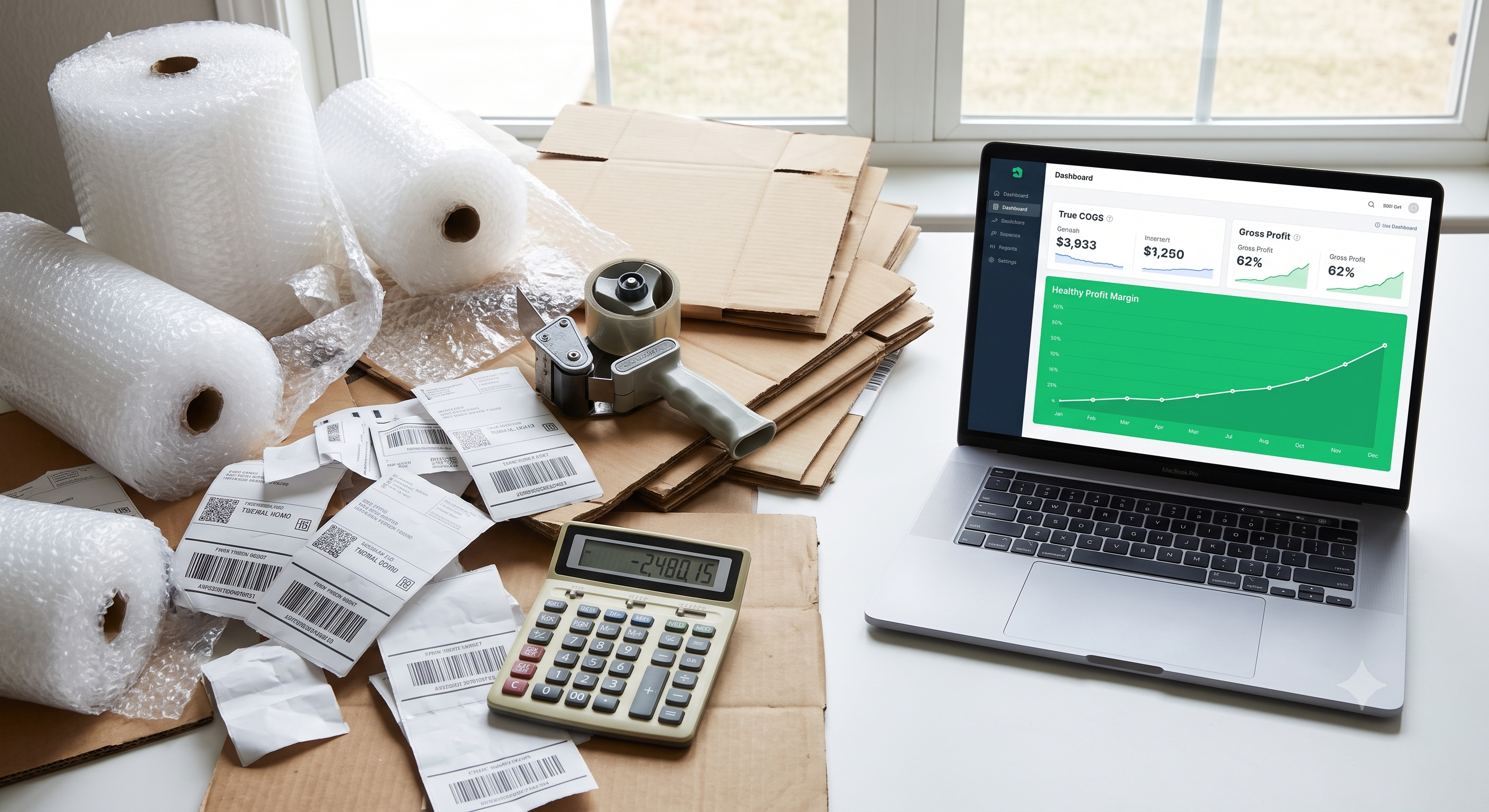
If you sell physical products online, you already know the pressure.
Every e-commerce platform, from Etsy to Shopify, constantly pushes you to offer "Free Shipping." We are told that buyers abandon their carts if they see a shipping fee, and that to compete with Amazon Prime, we have to eat the cost of postage.
So, you toggle the "Free Shipping" badge on your store. Your conversion rate goes up. Orders start rolling in. You spend your entire weekend packing boxes, feeling like a massive success. But when the end of the month rolls around and you look at your bank account... the math just doesn't make sense. You worked twice as hard, but your bank balance barely moved.
If this sounds familiar, you might have fallen into the "Invisible Inventory" trap. You might actually be paying your customers to take your products.
The Reality of "Invisible" Packaging Costs
When most makers calculate their Cost of Goods Sold (COGS), they are pretty good at tracking the core ingredients. If you make soap, you know exactly what your lye and olive oil cost. If you 3D print, you know the cost of the filament.
But a product isn't finished until it safely reaches the customer's doorstep.
**Here is what a typical "Free Shipping" order actually costs behind the scenes:
**
The 6x6x6 corrugated shipping box: $0.85
Two feet of protective hex-wrap or bubble wrap: $0.40
The 4x6 thermal shipping label: $0.05
The branded tissue paper and thank-you card: $0.30
The heavy-duty packing tape: $0.15
The actual USPS/Canada Post shipping rate: $7.50
Before you even factor in the raw materials of the product itself or your own hourly labor, it costs $9.25 just to put the item in the mail. If you are selling a $20 item and offering "Free Shipping," your profit margin has already been vaporized by corrugated cardboard and tape.
Why Spreadsheets Fail at Shipping Math
The reason makers lose money on shipping isn't because they are bad at math; it's because spreadsheets are terrible at tracking "sub-assemblies."
In a standard spreadsheet, you might have a row for your product that says it costs $5 to make. But when an order comes in, do you remember to manually go to another tab and deduct one cardboard box, one shipping label, and calculate the tape? Usually not. Those packaging materials become "invisible expenses" that quietly bleed your business dry.
Treat Your Boxes Like Raw Materials
To survive the pressure of modern e-commerce, you have to stop treating packaging as an "office supply" and start treating it as a raw material.
When I was running my own studio, the frustration of manually calculating the cost of bubble wrap and boxes for every single order drove me crazy. It’s exactly why I built Vercos ERP.
I needed a system where my "Bill of Materials" (the recipe for my product) didn't just stop at the physical item. In Vercos ERP, when an order syncs from your Shopify or Etsy store, the system doesn't just deduct the product from your shelf. It automatically deducts the exact fractional cost of the shipping box, the label, and the packaging materials from your inventory ledger.
It calculates your True COGS instantly, so you can see your exact net profit margin on every single order. No more guessing. No more working for free.
If you are going to offer free shipping, make sure you know exactly what it's costing you. It might be time to ditch the spreadsheet and get real visibility into your margins.
**TL;DR: **
-
Offering "Free Shipping" without calculating exact packaging costs is the leading cause of negative profit margins for small craft businesses.
-
Cost of Goods Sold (COGS) must include "invisible inventory" such as corrugated boxes, thermal labels, bubble wrap, and packing tape, which often add $1.50+ to the cost of every order.
-
Manual spreadsheets fail to accurately track packaging sub-assemblies, leading makers to drastically overestimate their net profits.
-
Using a manufacturing system like Vercos ERP allows makers to bundle packaging materials into their product recipes, automatically deducting packaging costs and calculating True COGS the moment an Etsy or Shopify order occurs.