Beyond 'Materials x 3': The Physics-Based Guide to Pricing Your Candles and 3D Prints
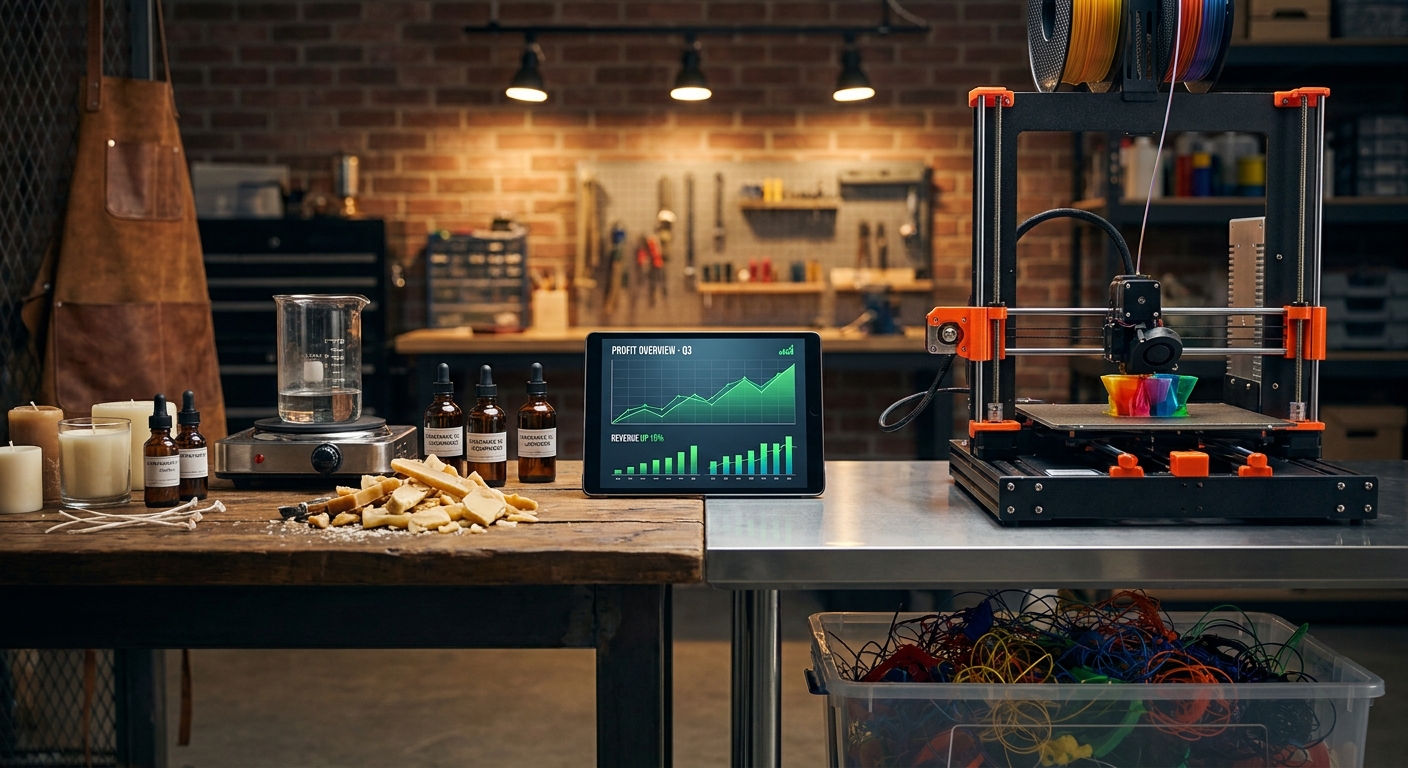
Most pricing advice for makers is dangerously simple. You’ve probably heard the old refrain: “Just take your material costs and multiply by three or four.”
If you’re running a hobby, that’s fine. But if you’re trying to build a sustainable business—the kind that pays your mortgage and doesn't just buy more supplies—that formula is a trap. It ignores the laws of physics.
Whether you’re pouring soy wax or printing PETG, your materials don't just transform into products with 100% efficiency. There is waste, evaporation, machine wear, and the dreaded "bottom-of-the-bottle" syndrome.
As someone who built Vercos ERP because I was tired of my spreadsheets lying to me about my margins, I want to dive into the real math of pricing candles and 3D prints.
The “Hidden Leakage” in Candle Pricing
Candle makers often struggle with a math problem that looks simple on paper but is messy in the workshop. You buy a 16oz bottle of fragrance oil, and your recipe calls for 1.5oz. You assume you have 10.6 candles in that bottle.
You don’t.
1. The Fractional Depletion Trap
Between the oil that clings to the side of the beaker and the last few grams you can’t quite pour out of the bottle, you’re losing 2-5% of your most expensive ingredient. If your pricing spreadsheet doesn’t account for this "fractional waste," your COGS (Cost of Goods Sold) is already wrong.
2. Curing Waste and Weight Loss
Soap makers know all about curing loss, but candle makers often ignore it. Depending on your wax blend, you can lose a fraction of a percentage of weight during the curing process. More importantly, you have to account for the "pour waste"—the wax left in the melting pitcher.
The Pro Formula:
Material Cost = (Weight Used + 10% Waste Buffer) x Unit Price
The “Invisible Costs” of a 3D Print Farm
If you’re pricing 3D prints based solely on the grams of filament shown in your slicer, you’re likely losing money on every job. A 100g print does not cost 10% of a 1kg spool.
1. The “Purge and Poo” Problem
If you’re running multi-color prints (like on a Bambu Lab AMS or Prusa MMU), your waste-to-product ratio can be staggering. Sometimes the purge tower weighs more than the actual model. If you aren't tracking that waste as part of the job cost, your margins are being flushed down the scrap bin.
2. Machine Hours & Nozzle Depreciation
Your printer is a physical asset that is slowly dying. Every hour it runs brings it closer to a fan failure, a belt snap, or a worn-out nozzle.
- Electricity: Usually negligible ($0.05 - $0.15 per hour), but it adds up on 60-hour prints.
- Maintenance: You should be adding a "Machine Tax" to every print—roughly $0.50 to $1.00 per hour—to fund your next printer or replacement parts.
The Unified Theory of Profitable Pricing
To move from "Artisan" to "Manufacturer," you need to stop thinking about price and start thinking about The Stack.
- True COGS: Raw materials + actual waste (fractional grams/filament scraps) + packaging.
- Labor: Your time isn't free. If you wouldn't hire someone else to do the work for the "profit" you're making, you aren't charging enough.
- Overhead: Rent, software (like Vercos ERP), marketing, and shop towels.
- The Profit Margin: This is what the business keeps to grow.
The Formula: (True COGS + Labor + Overhead) / (1 - Desired Profit Margin %) = Retail Price
Why Spreadsheets Fail (and Why We Built Vercos)
You can build a spreadsheet to track all of this. I did. It had 14 tabs, 200 hidden rows, and it broke every time I bought a new fragrance oil at a different price point.
We built Vercos ERP to be the "active brain" of your workshop. It doesn't just list your inventory; it understands the physics of your making:
- Fractional Deduction: It deducts 1.5oz of oil from a 16oz bottle and knows exactly what that specific 1.5oz cost you, even if you have three bottles bought at different prices.
- Waste Tracking: It factors in your "spaghetti" 3D prints or your candle pour waste automatically so your COGS is always based on reality, not a theoretical perfect world.
- Batch-to-Unit Conversion: It handles the math of turning a 10lb wax melt into 24 individual jars, tracking the cost of the wick, the lid, and the label along the way.
The Bottom Line
Pricing isn't a "vibe." It’s math. If you want to scale your 3D print farm or your candle studio, you have to stop guessing. Stop looking at what your competitors on Etsy are charging—half of them will be out of business in six months because they didn't account for their waste.
Charge for the grams you use, the grams you waste, and the hours you sweat. That’s how you build a craft business that actually lasts.
Ready to stop the spreadsheet chaos? Try Vercos ERP for free and see your real margins for the first time.
TL;DR Summary
- Simple multiplier formulas often fail because they ignore physics-based waste like fractional oil depletion and filament purge towers.
- True COGS must include a waste buffer (typically 2-10%) and machine depreciation to ensure the business can fund future repairs.
- Profit margin is distinct from labor; if you wouldn't hire someone for the remaining profit, your pricing is too low.
- Specialized ERP software outperforms spreadsheets by tracking real-time costs and inventory depletion across different purchase price points.