Maker ERP: Why 'Inventory Tracking' Is Failing Your Workshop
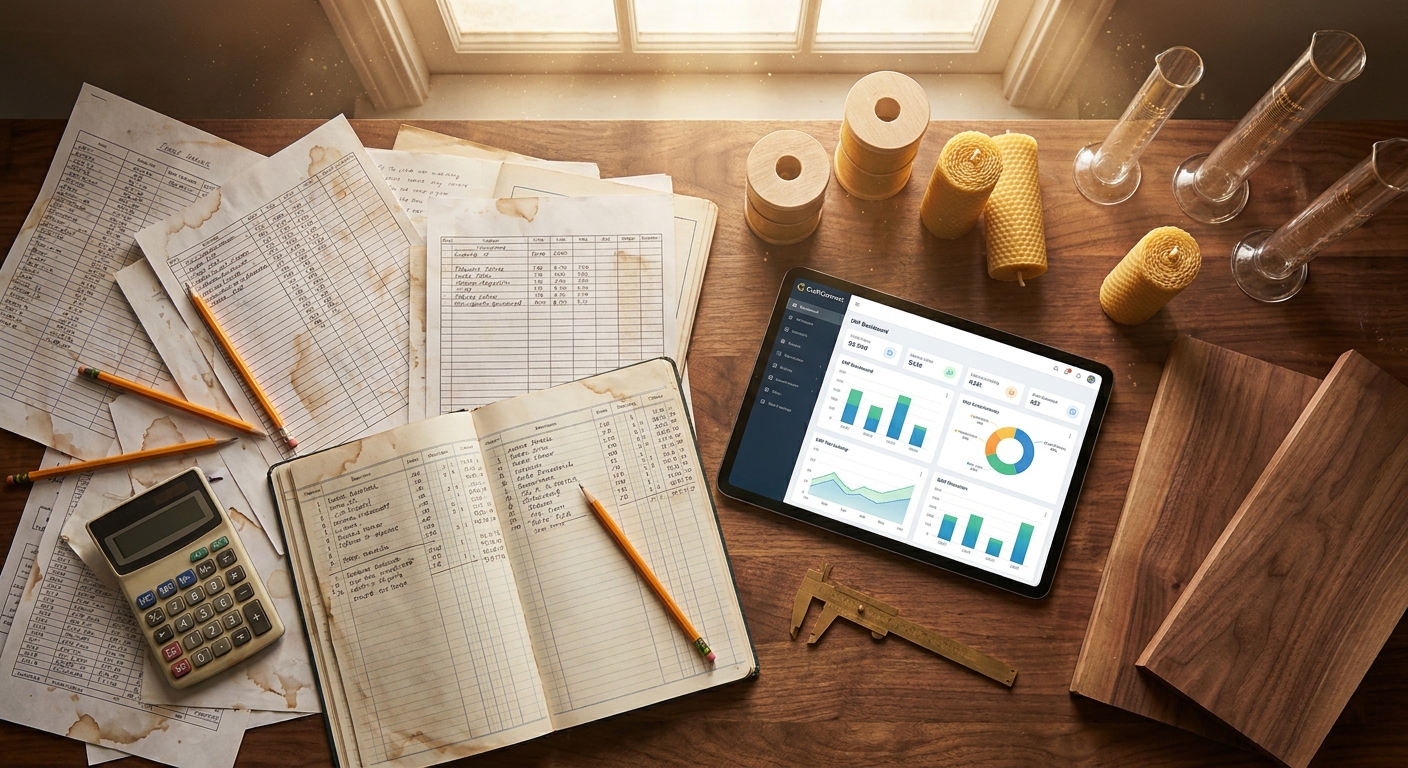
The Spreadsheet Ceiling: When Your Craft Becomes a Calculation Problem
You started your business to make things. You’re a candle maker, a 3D print farm operator, or a woodworker. You’re an artisan by trade and, out of necessity, you’ve become a part-time accountant and a full-time spreadsheet wrangler.
At first, a simple inventory list worked. You had a column for "Wicks" and a column for "Wax." But as you scaled, the math got weird.
How do you account for the 4.2 grams of fragrance oil that stayed stuck to the side of the pouring pitcher? How do you track the cost of a 3D print that failed at 90% completion? How do you move from a "loaf" of soap to 12 individual bars while accounting for water weight loss during a 6-week cure?
This is the point where most makers realize that "Inventory Tracking" is a passive activity, but manufacturing is an active process.
You don’t need an inventory list. You need a Maker ERP (Enterprise Resource Planning).
Passive Inventory vs. Active ERP: What’s the Difference?
Most software marketed to artisans (like Craftybase or Inventora) acts as a digital ledger. It’s a list of what you bought and what you sold. That’s fine for a reseller, but for a maker, it’s incomplete.
The Passive Inventory Approach:
- The Logic: "I have 10 bottles of oil. I sold a candle. I now have 9.9 bottles of oil."
- The Flaw: It doesn't account for waste, curing time, or fractional grams. It treats your workshop like a retail shelf, not a production floor.
The Maker ERP Approach (Vercos ERP):
- The Logic: "I am initiating a batch of 24 candles. This will deduct 1,240g of soy wax and 120ml of oil. It will also log 2 hours of 'pouring time' and move these units into a 'Curing' state for 14 days before they are available for sale."
- The Benefit: It tracks the physics of your business. It knows that your inventory is constantly changing state—from raw material to work-in-progress (WIP) to finished good.
Why Most ERPs Fail the "Maker Test"
If you search for "Manufacturing ERP," you’ll find heavyweights like Katana or MRPeasy. These are powerful tools, but they often feel like wearing a tuxedo to a woodshop.
- The Price Tag: Paying $350/month before you’ve even turned a profit is a non-starter.
- The Jargon: You shouldn't need a degree in supply chain management to understand "Bill of Materials" (BOM) when you just call it a "Recipe."
- The Rigidity: Traditional ERPs don't understand that a woodworker might use a "board foot" for one project and an "off-cut" for another. They don't account for the "spaghetti waste" of a failed 3D print.
Vercos ERP was built by makers who got frustrated with exactly these problems. It’s industrial-grade logic without the corporate bloat.
The Three Pillars of a True Maker ERP
If you’re looking to upgrade from "Spreadsheet Chaos" to "Total Operational Clarity," your software needs to handle these three things perfectly:
1. Fractional Deduction (The Gram-Scale Accuracy)
In the world of high-end skincare or candle making, profit margins live in the fractions. If you’re rounding up your fragrance oil usage to the nearest ounce because your software can't handle decimals, you are literally pouring your profit down the drain. A Maker ERP must track materials down to the fractional gram or milliliter.
2. The "Loaf-to-Unit" Conversion
Whether it’s a loaf of soap being cut into bars or a 1kg spool of filament being turned into 40 tiny figurines, your software needs to understand yield.
- How many units did the batch actually produce?
- What was the waste percentage?
- What is the final COGS (Cost of Goods Sold) for one of those units?
3. Automated Tax Compliance (The Schedule C Ghost)
Tax season is usually a nightmare of scrolling through Shopify orders and cross-referencing receipts. A Maker ERP should be your "active financial brain." Because Vercos tracks every batch and every material deduction in real-time, your COGS reports for tax forms (like Schedule C or T2125) are generated automatically. No guessing. No panic.
Stop Managing Lists. Start Running an Engine.
Running an artisan business is hard enough without the administrative overhead. If you find yourself spending more time updating cells in Excel than you do at the workbench, you’ve hit the Spreadsheet Ceiling.
It’s time to move to a tool that respects the complexity of your craft.
Vercos ERP provides the precision of a CNC machine for your business operations. It’s built for the person who cares about fragrance loads, board feet, layer shifts, and—most importantly—profitable margins.
Ready to see what your real margins look like? Try Vercos ERP for free and move from guessing to knowing.
TL;DR Summary
- Traditional inventory lists are passive and fail to account for the actual physics of manufacturing, such as waste and curing time.
- A Maker ERP tracks the active transition from raw materials to work-in-progress and finally to finished goods.
- Most industrial ERPs are too expensive and complex, whereas a Maker ERP uses artisan-friendly logic and terminology.
- Accurate COGS and tax compliance require software that can handle fractional measurements and unit conversions automatically.