The Gross Margin Delusion: Why Your '60% Profit' is Leaving You Broke
The Gross Margin Delusion: Why Your "60% Profit" is Leaving You Broke
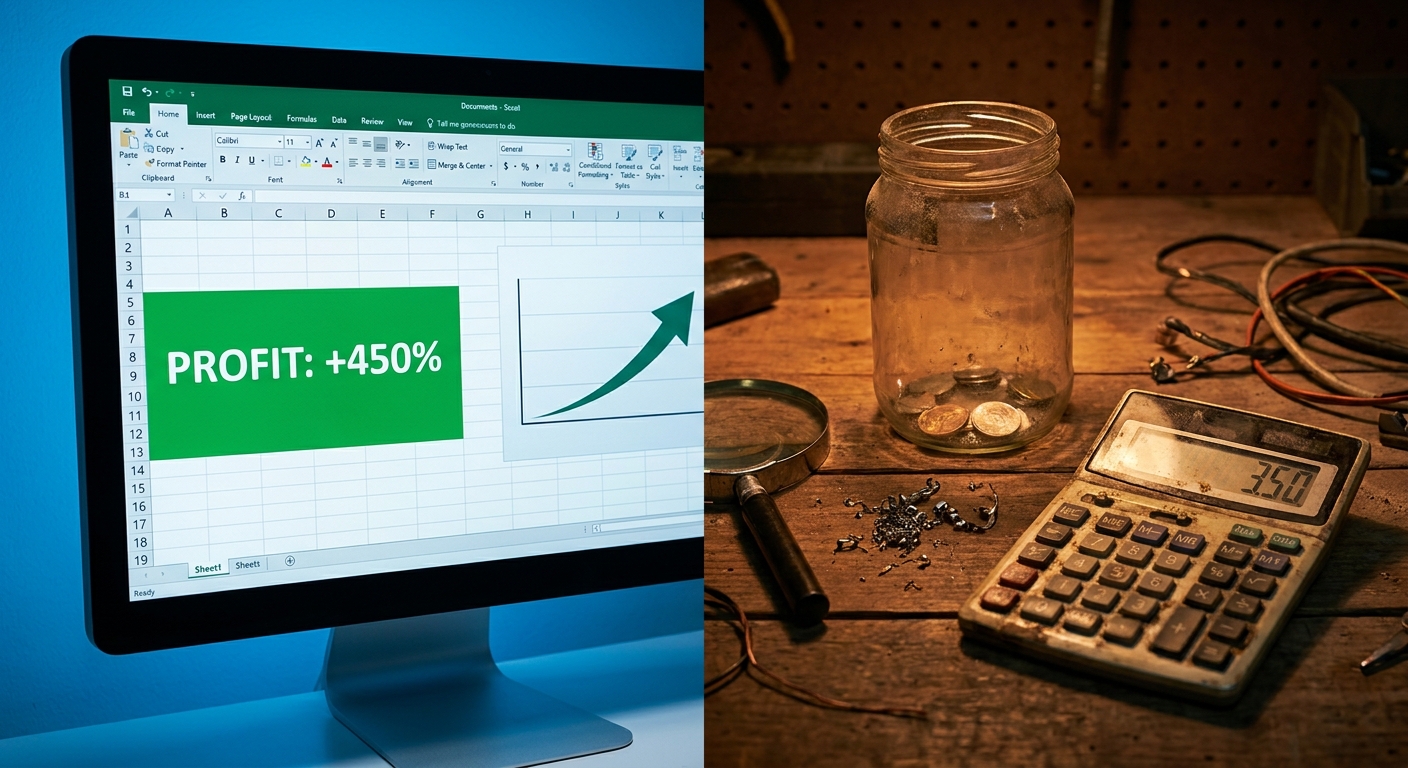
You’ve just finished a massive production run. The candles are cured, the 3D prints are cleaned up, or the soap bars are finally cut and curing on the rack. You look at your spreadsheet—the one you spent hours building—and it tells you that you have a 60% profit margin.
You’re winning, right?
But then you look at your business bank account at the end of the month, and the math doesn’t add up. After paying for a new roll of filament, a fresh drum of soy wax, and your Shopify subscription, there’s barely enough left to cover a nice dinner, let alone a paycheck for yourself.
This is the Gross Margin Delusion. It’s the gap between the "theoretical profit" on your recipe sheet and the "actual profit" that hits your pocket. As a maker who moved from the workshop floor to building software, I’ve seen this play out a thousand times.
Let’s look at why your profit margin is lying to you and how to fix it before it sinks your studio.
1. The "Recipe Card" vs. The Workshop Floor
Most makers calculate their profit margin like this:
Materials Cost + Packaging = COGS (Cost of Goods Sold).
Sales Price - COGS = Profit.
If your materials cost $4 and you sell the item for $10, your spreadsheet says you have a 60% margin. But your spreadsheet assumes a perfect world.
In the real workshop, the world is messy.
The Invisible Eaters of Margin:
- The Fragrance Oil Residue: You poured 100g of oil into your candle batch, but 2.5g stayed stuck to the side of the beaker. That’s 2.5% of your most expensive ingredient gone instantly.
- The 'Spaghetti' Tax: In 3D printing, your margin isn't based on the finished weight of the dragon; it’s based on the grams pulled from the spool. This includes support structures, brims, and the occasional 3:00 AM nozzle clog that results in a pile of plastic waste.
- The Loaf-to-Bar Shrinkage: Soap makers, you know the pain. You make a 2kg loaf, but by the time it cures and the water evaporates, you’re selling 1.8kg of product. If you’re calculating margin on the raw weight, your profit is literally evaporating.
The Vercps Fix: We built a Fractional Deduction Engine. Instead of just counting "1 bottle of oil used," Vercos tracks the exact grams or milliliters. It accounts for waste factors automatically, so your COGS is based on reality, not a recipe.
2. The "Labor is Free" Trap
This is the biggest margin killer in the artisan world. If you aren't factoring your hourly rate into your COGS, you don't have a profit margin; you have a job that pays $0.
If a custom jewelry piece takes you 3 hours to assemble and your materials cost $20, selling it for $100 looks like an 80% margin. But if you paid yourself a modest $25/hour, your actual cost is $95. Your real profit is $5.
That’s a 5% margin. One shipping error or a broken gemstone, and you’re now paying the customer to take your jewelry.
3. The Multi-Channel Leakage
If you sell on Etsy, Shopify, or through a wholesale platform like Faire, your margin is being nibbled to death by "platform taxes."
- Payment Processing Fees: Usually 2.9% + $0.30.
- Marketplace Fees: 6.5% (Etsy) or 15-25% (Faire).
- The "Free Shipping" Illusion: Shipping is never free. If you aren't building the exact cost of the label and the cardboard box into your margin, you’re losing 10-15% of your profit per order.
When you add these up, that "60% margin" suddenly drops to 30%. When you subtract your labor and waste, you’re often left with 5-10%—the danger zone.
4. Gross Margin vs. Net Profit: The Only Number That Matters
To run a sustainable business, you need to stop obsessing over Gross Margin (Sales - Materials) and start tracking Contribution Margin (Sales - Materials - Labor - Fees).
Here is how to audit your top-selling product today:
- Calculate true material cost: Include the waste (the 5% you throw away).
- Clock your time: Don't guess. Use a timer. Even for packing the box.
- Subtract the platform fee: Use the highest fee you pay (e.g., Etsy).
- Subtract the shipping cost: The actual cost of the label and the mailer.
If that final number is less than 20%, you need to raise your prices or find a way to automate your production.
Why Spreadsheets Fail (And Why We Built Vercos)
You can track all of this in a spreadsheet, but as your business grows, the spreadsheet becomes a part-time job itself. You forget to update the price of silver. You forget to account for the 10% of failed prints this month.
Vercps ERP was designed to be the active financial brain of your workshop. It syncs with your shop to pull in real-time orders, calculates the exact fractional material depletion for every batch, and factors in your labor time.
It moves you from "guessing" your profit margin to "knowing" it with industrial-grade precision.
Stop working for free. Stop letting the 'Invisible Eaters' kill your business.
[Ready to see your real margins? Try Vercos ERP for free today.]
TL;DR Summary
- Gross Margin often ignores 'Invisible Eaters' like material waste, residue, and product shrinkage.
- Failing to factor your own hourly labor rate into costs turns your business into a $0/hour hobby.
- Marketplace fees and shipping costs significantly reduce theoretical margins, often by 20-30%.
- Successful makers track Contribution Margin—Sales minus Materials, Labor, and Fees—for true sustainability.