Fragrance Oil Math: How to Calculate the Exact Cost of Your Candle Pours
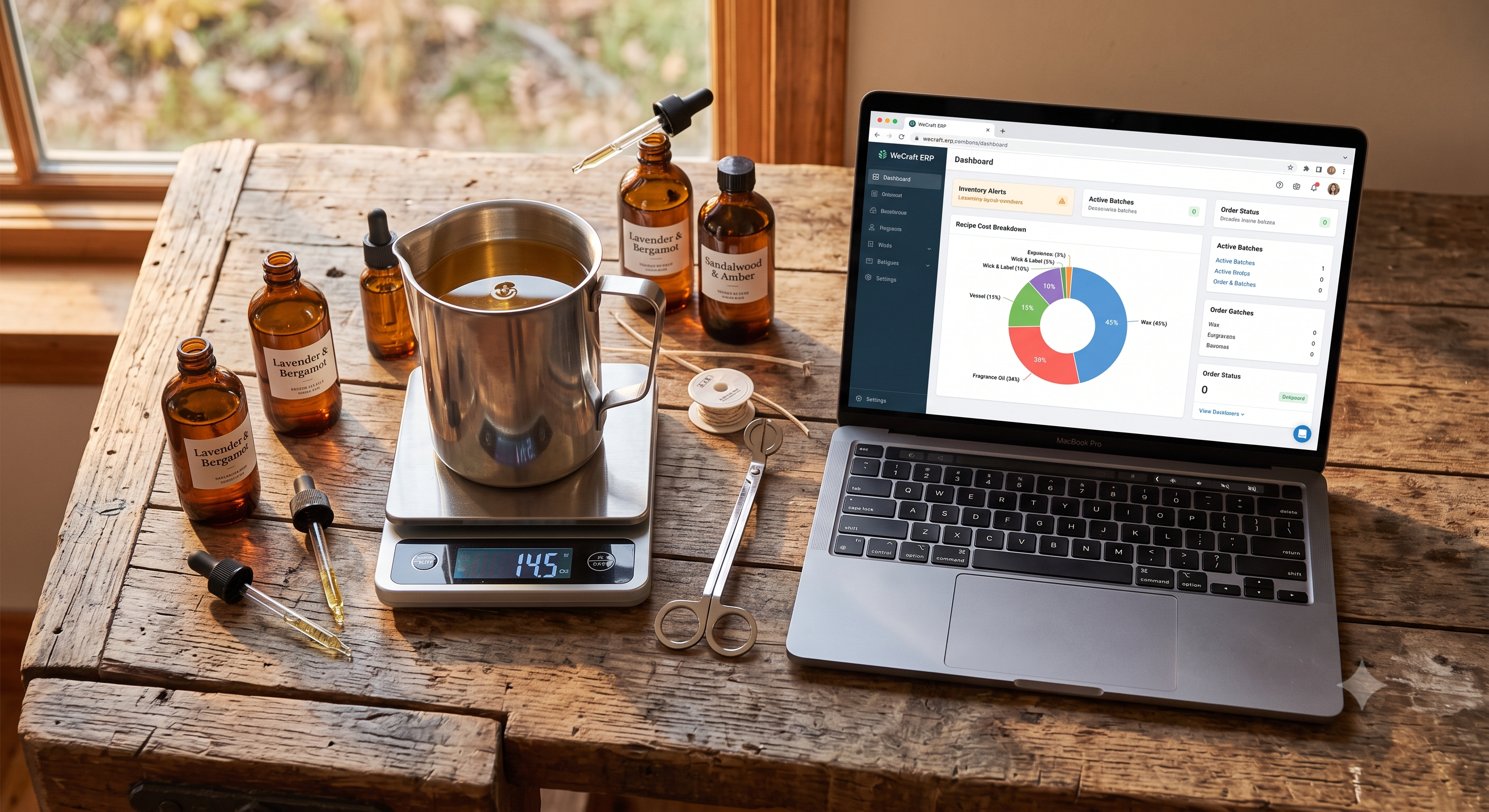
There is nothing quite like the feeling of a new shipment of fragrance oils arriving at the studio. Unboxing those amber bottles and testing new scent profiles is the absolute best part of running a candle business.
But then comes the worst part: The math.
If you want your business to actually survive, you have to price your candles correctly. That means you need to know exactly what every single pour costs. But unlike buying a pre-made t-shirt and reselling it, candle making is a manufacturing process. You buy a 16oz bottle of fragrance oil and a 45lb box of soy wax, but you sell an 8oz candle.
Bridging the gap between bulk supplier purchases and individual retail products is where most candle makers completely lose control of their profit margins. Here is why fragrance oil math is so frustrating, and how to finally get it right.
The "Fragrance Load" Formula
The most common mistake I see makers make in their spreadsheets is confusing the volume of the vessel with the weight of the wax. An 8oz jar does not hold 8oz of wax and oil by weight.
To find your true costs, you must calculate your materials by weight (grams or ounces) using your Fragrance Load percentage. Here is the standard baseline formula for a 10% fragrance load:
Total Wax Weight x 0.10 = Fragrance Oil Weight Needed
If you are pouring a batch that requires 1,000 grams of wax, you need 100 grams of fragrance oil. To find the cost, you have to divide the total price you paid for the bulk bottle of oil by its total weight, finding your exact cost-per-gram. You then multiply that cost-per-gram by 100.
Doing this math once on a scrap of paper is easy. Doing it for 45 different scent profiles, across 5 different vessel sizes, while supplier prices constantly fluctuate, is a nightmare.
The Hidden "Pitcher Tax" (Curing and Waste)
Even if your spreadsheet formulas are perfect, they are probably lying to you. Why? Because standard spreadsheets assume you operate in a perfect vacuum.
When you pour a batch of 10 candles, did all 100 grams of that expensive fragrance oil actually make it into the jars? No. A few grams were left clinging to the walls of the measuring glass. A few more grams were left at the bottom of the pouring pitcher. Plus, you will lose a tiny fraction of weight to evaporation during the curing window.
If your spreadsheet only tracks the "perfect" recipe amount, you are absorbing that wasted material as an invisible business loss. Over the course of a busy Q4 holiday season, that "pitcher tax" can easily eat hundreds of dollars of your hard-earned profit.
Ditch the Manual Math
I used to spend hours at midnight manually updating my Excel formulas every time a supplier raised the price of my favorite sandalwood oil by a few dollars. I was exhausted, and I was still guessing my margins.
That frustration is exactly why I built Vercos ERP. It is a manufacturing engine designed to handle fractional liquid math automatically.
In Vercos ERP, you simply build your "Recipe." When you tell the system you just poured a batch of 10 candles, it automatically deducts the exact fractional grams of wax and fragrance oil from your digital inventory. It factors in your historical waste margins, calculates your true Cost of Goods Sold (COGS) based on the most recent prices you paid your suppliers, and instantly updates your Shopify and Etsy stock.
You didn't start making candles to become a data entry clerk. If you are ready to get back to the fun part of the craft, it’s time to let a proper system handle the math.
TL;DR Summary
- To maintain profitable margins, candle makers must accurately track the fractional cost of bulk fragrance oils and wax used in every pour.
- Manual spreadsheets fail to account for fluctuating supplier prices and often ignore the "pitcher tax"—the fractional grams of oil and wax lost to pouring residue and curing evaporation.
- A standard fragrance load calculation requires converting bulk supplier costs down to a precise cost-per-gram for every single recipe variation.
- Vercos ERP automates candle making math by instantly calculating true Cost of Goods Sold (COGS), dynamically adjusting for supplier price changes, and deducting fractional materials from inventory the moment a batch is logged.