Curing Waste Explained: Why Your Loaf-to-Bar Soap Math is Always Off
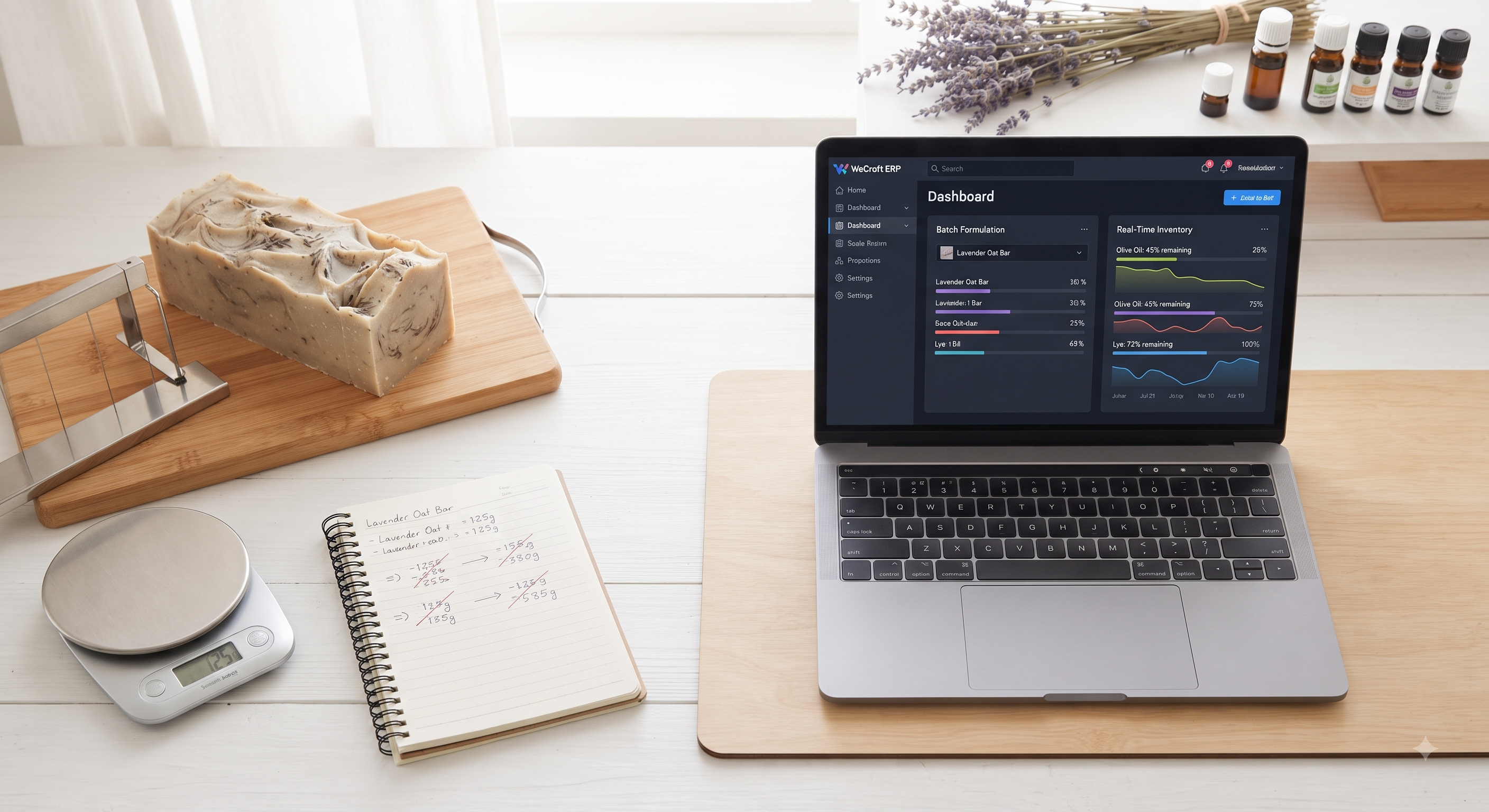
If you’re anything like me, you didn’t start making cold process soap because you have an undying passion for accounting. You started because you love the alchemy of it. There is an unmatched satisfaction in running your oils through a lye calculator, hitting that perfect emulsion trace, pouring a vibrant, textured loaf into your wooden mold, and waiting for the morning reveal.
But if you’ve ever tried to sit down and calculate your true Cost of Goods Sold (COGS) per bar, you’ve likely run straight into a wall that standard e-commerce tools just aren’t built to climb.
You poured a batch designed to yield 10 bars. You priced each bar out by dividing your total ingredient cost by 10. But by the time your bars finished their 4-to-6-week curing cycle, things didn't add up. You lost a bar to a bad bevel, trimming left you with crumbly scraps, and water weight evaporation completely threw off your final cost per ounce.
If your loaf-to-bar math is constantly leaking money, you aren't doing anything wrong—you’re just caught in the classic trap of soapmaking inventory math. Let’s look at why your calculations are off, and how fixing your workflow can finally protect your margins.
The Loaf-to-Bar Disconnect: Where the Math Breaks Down
Most soap makers calculate their margins using a simple linear equation: take the total cost of the oils, lye, and liquid, divide by the number of bars cut, and call it a day.
Unfortunately, physical soap is a living, changing product during its cure. That simple division ignores three massive profit-killers:
1. The Water Weight Evaporation Trap
When you formulate a batch, you weigh out your water (or milk, or aloe juice). That water has a weight and a cost. But as your soap sits on the curing rack for four to six weeks, water molecules steadily evaporate into the air.
If you weighed your bars immediately after cutting them, they would be heavier than they are on week four. If you base your profit margins on the wet weight right out of the mold, you are overestimating the actual mass of the product your customer is holding—and underestimating your true material density per bar.
2. Trimming, Beveling, and Scrap Waste
A loaf of soap rarely comes out of the mold looking like retail-ready bars straight away. You have soda ash to plane off, uneven end-pieces to trim, and sharp edges to bevel with a soap planer.
Those shavings aren't free. That is real olive oil, coconut oil, and expensive shea butter ending up in the trash bin or sitting in a scrap bucket. If your inventory system assumes 100% of the loaf turns into sellable bars, your margins are entirely fictional.
3. Fragrance and Additive Loss
Volatile fragrance oils and essential oils degrade slightly or flash off during the saponification heat spike and the long curing evaporation process. Furthermore, botanicals embedded on top can discolor or flake off. If you are calculating your scent cost based solely on what went into the mixing pitcher, you aren't tracking the actual aromatic yield of the finished bar.
The Formula: How to Calculate True Soap COGS
To find out what a single bar of soap actually costs you to make, you have to account for the evaporation delta and trim loss. Use this simple formula:

- Total Raw Material Cost: The exact cost of your base oils, lye, liquids, colorants, and essential/fragrance oils.
- Packaging: Belly bands, labels, boxes, or shrink wrap.
- Scrap/Trim Value: The realistic percentage of the batch lost to beveling and imperfections (usually 5% to 10% for intricate designs).
- Actual Yield: Notice this is not what you hoped to cut, but what actually passes quality control after the 4-week cure.
Stepping Away from the Spreadsheet Maze
If you are tracking your lye ratios, oil inventory, cure dates, and post-cut yields across a messy web of Excel sheets, notebooks, and calculator apps, you are spending more time playing data-entry clerk than artisan.
When your business scales and you start juggling multiple soap recipes alongside seasonal restocks, manual spreadsheets will quietly bleed your profit margins dry.
That exact frustration is why I stopped managing my studio on broken spreadsheets and built Vercos ERP.
Vercos ERP is an industrial-grade manufacturing and inventory engine built specifically by makers, for makers. It handles the complex multi-unit math that standard software ignores:
- Fractional Raw Material Tracking: Track your lye, sodium lactate, and expensive butters down to the exact fractional gram or milliliter.
- Batch Yield & Curing Logs: Log a soap batch, track your distinct curing windows, and automatically account for material depletion from loaf to final cured bar.
- Automated COGS: Instantly calculate your true cost per bar the second a production run is logged, factoring in waste and packaging.
- Multi-Channel Syncing: Connect your Etsy, Shopify, and in-person Square POS so your inventory syncs in real-time and you never oversell a batch that's still curing.
The Wrap-Up
Soap making is an art, but running a profitable studio is a science. Don't let hidden curing evaporation and trim waste eat the profits you've earned on the workbench.
Take a look at your batch sheets this weekend, factor in your true post-cure yields, and make sure your pricing reflects the real work you put into every bar.
Keep making awesome stuff, and protect those margins!
TL;DR Summary
- Calculating true cold process soap margins requires tracking post-cure weight loss, trim waste from beveling, and actual sellable yield rather than raw mold volume.
- Standard e-commerce tools and spreadsheets fail to handle fractional lye and oil calculations, leading hidden evaporation and waste costs to quietly erode profit margins.
- Vercos ERP features a native multi-unit recipe and fractional deduction engine designed specifically for batch makers, automating soap COGS, cure tracking, and multi-channel inventory syncs.